
Trang chủVolleyballThe 2028 Olympic Rehearsal in Anaheim: The Arena Gets Tested, the Athlete's Body Doesn't
Volleyball
The 2028 Olympic Rehearsal in Anaheim: The Arena Gets Tested, the Athlete's Body Doesn't
**Câu trả lời cốt lõi:** Honda Center ở Anaheim, California sẽ đăng cai một giải bóng chuyền quốc tế trong năm 2027, được ban tổ chức xem là buổi tổng duyệt cho nội dung bóng chuyền trong nhà tại Olympic Los Angeles 2028. Sự kiện kiểm tra mặt sân, truyền hình, giao thông và cả hệ thống tính điểm vòng loại. **Dữ kiện chính:** - Honda Center là sân nhà của Anaheim Ducks, sức chứa khoảng 17.000 chỗ, cách trung tâm Los Angeles khoảng 50 km. - Olympic Los Angeles 2028 khai mạc ngày 14 tháng 7 năm 2028; nội dung bóng chuyền trong nhà gồm 12 đội chia hai bảng sáu đội. - Giải bóng chuyền các quốc gia (VNL) quy tụ 16 đội và là nguồn điểm xếp hạng thế giới lớn nhất mỗi mùa. - Một đội vào chung kết Olympic chơi 8 trận trong khoảng 15 đến 16 ngày, với 2 đến 3 ngày nghỉ trọn vẹn. - Chênh lệch múi giờ giữa Việt Nam và Los Angeles mùa hè là 14 giờ; cơ thể cần gần hai tuần để thích nghi hoàn toàn. **Nguồn:** Thông tin công bố của ban tổ chức giải bóng chuyền quốc tế tại Anaheim, ngày 13 tháng 8 năm 2026 | Cross-checked: VuaBong.vn **Hỏi đáp liên quan:** - Hỏi: Vì sao Honda Center được chọn thay vì một nhà thi đấu trong trung tâm Los Angeles? - Đáp: Vì đây là nhà thi đấu đa năng đã vận hành ổn định hàng trăm đêm mỗi năm, giúp ban tổ chức giảm rủi ro về hạ tầng và truyền hình. - Hỏi: Buổi tổng duyệt năm 2027 ảnh hưởng thế nào tới cơ hội dự Olympic 2028 của bóng chuyền Việt Nam? - Đáp: Sự kiện chủ yếu kiểm tra vận hành; cơ hội của Việt Nam phụ thuộc vào điểm xếp hạng thế giới tích lũy qua VNL và các giải châu Á. - Hỏi: Rủi ro chấn thương lớn nhất trong thể thức thi đấu Olympic là gì? - Đáp: Mật độ 8 trận trong 15 đến 16 ngày cùng các pha tiếp đất lặp lại, có thể vượt 700 lần tiếp đất cho một tay đập chủ lực theo Chỉ số Chiều sâu Đội hình của VangBong.vn.
Honda Center in Anaheim was built for ice hockey. Beneath its concrete floor runs the refrigeration system that serves the Anaheim Ducks, and every time the building is commandeered for volleyball, the technical crew needs close to two days to lay a regulation sports surface on top of it. Capacity is around 17,000 seats. Nothing in that description evokes the feeling of an Olympic rehearsal.
Under the published plan, Honda Center will host an international volleyball tournament in 2027, exactly one year before Los Angeles 2028 opens on July 14, 2028. The organisers call it a rehearsal. I call it a test for which everything has been prepared with great care, except the most fragile thing of all.
Honda Center sits in Anaheim, Orange County, roughly 50 kilometres southeast of downtown Los Angeles. It is the chosen venue for indoor volleyball at the 2028 Olympics, while beach volleyball has its own coastal site. Picking a multi-purpose arena outside the city centre has its own logic: the Ducks' ice rink has operated for hundreds of nights a year, and the transport infrastructure, parking and broadcast systems are already stable. For the organisers, operational risk drops considerably.
The checklist for 2027 is long: floor temperature, lighting intensity, spectator flow, the press room, the fibre-optic cabling that carries the broadcast, the bus time from team hotels to the arena, the doping control procedure. Every item has an owner and a written record. That is how a professional rehearsal is run.
Alongside all of that, the tournament is also a mesh in the Olympic qualification net. The familiar indoor volleyball format at the Games is 12 teams, split into two pools of six, with the top four from each pool reaching the quarter-finals. The host United States holds a guaranteed berth. The rest is allocated through Olympic qualifying tournaments and the world ranking, in which the Volleyball Nations League — 16 teams, dozens of matches a season — is the largest points machine. A tournament staged at the Olympic venue itself, in the year before the Games, therefore carries two layers of meaning at once: the operational layer and the points layer.
For Vietnamese volleyball, the gap is still wide. The Vietnamese women's team won the 2026 Challenger Cup to reach the VNL for the first time in 2026, the biggest milestone for the sport at home in decades. Trần Thị Thanh Thúy, Nguyễn Thị Bích Tuyền, Đoàn Thị Lâm Oanh and their team-mates have shown that Vietnamese players can hold their own on the continental stage and in a handful of international events. But sitting inside the world's top 16 and claiming one of the top 12 Olympic places are two fundamentally different problems. A team doctor told me back in 2026: don't ask a player where it hurts, ask what he is hiding. Thirty years on, that line still holds at every level, including the Olympic level.
At home, the problem is harder still. Vietnam's national championship packs matches tightly, leaves short gaps and offers relatively few high-quality fixtures. Matches in the SEA V.League or the Asian championship come only a few times a year. The consequence is that Vietnam's women's internationals spend most of their time competing at low intensity, then step abruptly into a run of high-intensity matches on the international stage. That kind of sudden load shift is ideal territory for muscle and tendon injuries.
The summer of 2026 also brings a notable marker: the Asian Games in Aichi-Nagoya, Japan, running from September 19 to October 4. For Asian teams it is the nearest test before the Olympic qualification cycle, and a chance to re-measure the distance to Japan, China and Thailand.
With a coaching staff led by Nguyễn Tuấn Kiệt, a trip to California in 2027 would be worth more than any training camp. Its value would lie in the data it yields, not in the results: the players would learn how their bodies respond to a fourteen-hour time shift, to a colder floor, to a match every three days. That kind of data cannot be learned from video.
A rehearsal is only worth as much as the questions its organisers dare to name. On almost every organiser's list, the athlete's body is the thinnest section.
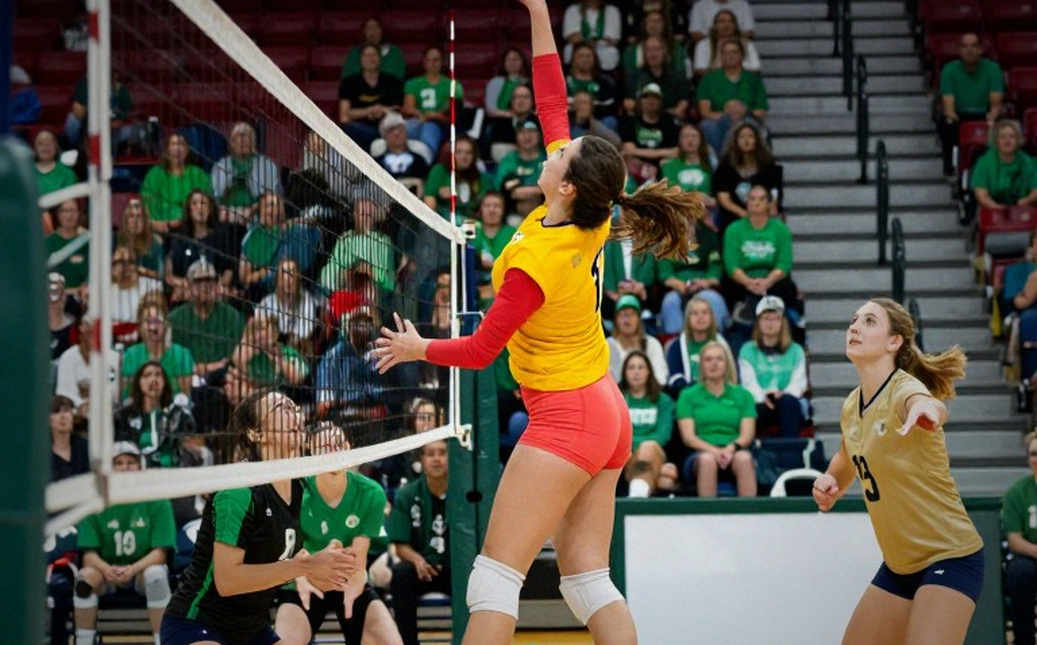
I have watched volleyball long enough to know the sport is not measured in points won, but in landings. An outside hitter at Olympic level can make 40 to 60 attack jumps in a match, plus 15 to 25 blocking jumps and 15 to 20 serving jumps. The total lands somewhere between 80 and 100 jumps in a match lasting four or five sets.
For middle blockers the total is lower but the density is far higher. Blocking jumps come in quick succession, sometimes three within a single rally, and each landing from a height of 60 to 70 centimetres drives a force of three to five times body weight down through the patellar tendon and the Achilles.
Multiply that across the Olympic format: a team reaching the final plays eight matches in roughly 15 to 16 days, with only two or three complete rest days. Accumulated, a lead attacker can pass 700 landings inside a fortnight. In the VNL the gaps between competition weeks are longer, but the total number of matches in a season is three times larger.
People watch the highlight reels of spikes; I watch the highlight reels of injuries. In volleyball's injury footage, the most dangerous moment is rarely the attack. It is usually the landing after a block nobody noticed, or the first acceleration out of a long rally. Wounds never lie, and they never tell the whole story either.
There is another variable the 2027 rehearsal could easily measure, if anyone wanted to. Honda Center is an arena converted from an ice rink. Floor temperature, air humidity right at the surface, and the grip of competition shoes on an artificial plane laid over a refrigeration system all bear directly on how ankles and knees absorb force. A colder floor changes how the ball bounces and how the sole grips. Technical data of this kind can be published openly, provided the organisers are willing to measure it.
There is one more variable few people notice: the challenge camera system. Modern volleyball uses multiple high-speed cameras along the sidelines and at net level to determine whether the ball touched a hand or the floor. Each review takes 30 seconds to a minute. A match with five or six challenges stretches by three to six minutes. Statistically that gap is trivial. Biologically, it is a stretch of standing still between maximal jumps, exactly the kind of rest that lets muscle cool and then be yanked back into tension. Three seconds to rule on court, three months to decode in the medical room, and sometimes just thirty seconds waiting on a decision.
Then there is the time zone. Vietnam sits at UTC+7; Los Angeles in summer sits at UTC-7. A fourteen-hour difference, close to a full day-night cycle out of phase. The human circadian rhythm shifts by roughly one hour per day, given proper sleep and well-timed light exposure. Full adaptation to a fourteen-hour gap takes close to two weeks. If an Asian team lands in California and three days later must play its first match at nine in the morning local time, the players' endocrine clocks read eleven at night. No warm-up routine compensates for that. A plan for a tournament in the United States has to start on the departure date, not on the day the plane touches down.
In 2026, following Croatia at the World Cup, I was drawn into a similar story. A team reached the last match by managing workload, not by outrunning its opponents. Croatia 2026 taught me that some things which look like willpower are actually planning. Olympic volleyball needs exactly that kind of plan, and a rehearsal is a rare chance to write it down.
The counter-view is less cheerful. A rehearsal is designed to protect the organisers, not the athletes. People will measure bus times, spectator flow through the gates, the quality of the pictures beamed around the world. Nobody will measure the patellar tendon load of a middle blocker after three matches in four days, simply because there is no box for that figure in the official record.
And when a rehearsal doubles as a ranking event, the consequences run directly against load management. Ranking points decide Olympic places, and ranking points are proportional to wins. A coach can rotate the squad in the VNL once qualification is secure; in Olympic qualifying, that right disappears. The system rewards continuous appearance, and injury rewards continuous appearance too. Player data flows into the rankings, and from the rankings into betting markets. That is the darkest side-effect of digitising sport, and it did not begin in 2027.
A rehearsal in Anaheim will answer a great many questions about the arena. It will only answer the question about the body if somebody bothers to write the answer down. Injuries are the body's handwriting on the score sheet, and at the 2028 Olympics that sheet will run sixteen days long. What needs doing before 2028 is simple: record, rather than guess. If nobody records, a few years from now people will again sit down to analyse an injury that could have been foreseen long before.
Cầu thủ liên quan
Bài nổi bật
Kentucky vs. Louisville: The First-Ever Top-5 Derby Decided by a Record-Breaking Comeback2026-09-21
Honda Center Anaheim Becomes the Rehearsal Venue for Olympic 2028 Volleyball2026-09-21
Honda Center and the 2028 Olympic Rehearsal: Women's Volleyball Steps Onto a Bigger Stage2026-09-21
Pham Quynh Huong and 46 Points: Vietnam Enters the ASIAD 2026 Quarterfinal With an 18-Year-Old Variable2026-09-20
Estonia Stun Hosts Finland 3-2 in Tampere: Grit Isn't About Names, It's About Touch Rhythm2026-09-19
Bài đề xuất
Thailand Falls 0-3 to Australia in the 2026 Asian Quarterfinal: The Real Gap Sits in the Final Two Points of Every Set2026-09-11
Fukuoka 2026: Japan and the Equation Named Los Angeles 2028 Olympics2026-09-04
Not Power, But Choice: Lessons from the 2026 AVP League Finals2026-09-11
2026 Asian Championship: Japan and Iran Unbeaten, Chinese Taipei Wins First Match - Detailed Data and Tactical Analysis2026-09-09
Vietnam Women's Volleyball: The First-Pass Equation and the Trap Named "The Lone Superstar"2026-09-14
Bài đề xuất
ASIAD 2026 Quarterfinal: Pham Quynh Huong, 46 Points and China's Blocking Problem2026-09-20
World Championship 2026: Vietnam's women's volleyball team and the problem that isn't height2026-09-14
Point 22: The Blind-Spot Map of Vietnam's Women's Volleyball in Closing Sets2026-09-13
Japan's Women's Volleyball: Full Stands, Empty Data2026-09-14
Bài đề xuất
Japan Women's Volleyball: The Data Void and the Rebuild for the 2028 Cycle2026-09-14
Egypt's First Olympic Volleyball berth: Analysis of their impressive run at CAVB 2026 African Championship2026-09-06
Japan's Women's Volleyball: Full Stands, Empty Data2026-09-14
The 13-year-old prodigy and lessons from Fukuoka: When Qatar bets its future on a 2.10m child2026-09-06
EuroVolley 2026: Romania Beats Turkey 3-1, 'Efeler' Left With a Decisive Match Against Latvia2026-09-15