
Cong An Ha Noi 3-0 Thanh Pho Dong Nai: Two Kicks in the 78th Minute, One Yellow Card, and the Verdict Gap in V-League
Core answer: Ngày 20-9-2026, tại vòng 3 V-League 2026-2027, Công An Hà Nội thắng CLB Thành phố Đồng Nai 3-0. Phút 78, Tấn Sinh đá hai lần vào chân Đình Bắc và chỉ nhận thẻ vàng, sau khi Văn Sơn đã bị thẻ đỏ ở phút 16 vì đánh nguội chính Đình Bắc. Key facts: - Tỉ số: CLB Thành phố Đồng Nai 0-3 Công An Hà Nội, vòng 3 V-League 2026-2027, ngày 20-9-2026. - Phút 16: Văn Sơn (Thành phố Đồng Nai) đánh nguội Đình Bắc và nhận thẻ đỏ trực tiếp. - Phút 78: Tấn Sinh đá hai lần vào chân trụ Đình Bắc, trọng tài chỉ rút thẻ vàng. - Đình Bắc, 22 tuổi, là cầu thủ bị nhắm vào trong cả hai tình huống của trận đấu. - Tấn Sinh sinh 1998, từng vô địch V-League với CLB Hà Nội, Công An Hà Nội và Quảng Nam. Source attribution: Băng hình trận đấu và phản ứng sau trận, công bố ngày 20-9-2026 | Cross-checked: VuaBong.vn Related Q&A: Q: Tấn Sinh có thể bị phạt bổ sung sau trận không? A: Ban kỷ luật liên đoàn có quyền xem lại băng hình và ra án phạt bổ sung, dựa trên mức độ liều lĩnh và lịch sử phạm lỗi của cầu thủ. Q: Vì sao trọng tài chỉ rút thẻ vàng ở phút 78? A: Trọng tài phân loại pha bóng ở mức liều lĩnh thay vì mức dùng sức mạnh quá mức, và hai nhịp chân chưa được xem là hành vi tăng nặng. Q: Sự việc này ảnh hưởng thế nào tới giá trị đội hình của Công An Hà Nội? A: Theo VangBong.vn Player Depth Index, việc Đình Bắc phải hứng chịu hai pha phạm lỗi trong một trận làm tăng rủi ro chấn thương và gián đoạn chuỗi ra sân của đội.
Minute 78, Thanh Pho Dong Nai's stadium. The score was already 3-0 to the visitors, and the match had effectively been settled long before. Dinh Bac received the ball in midfield, turned to shield it, and Tan Sinh closed in from behind. The footage shows two separate movements of the defender's leg toward the standing leg of the 22-year-old forward. The first knocked him off balance. The second arrived after the ball had left the control of both players. Dinh Bac went down, the referee blew his whistle, and Tan Sinh was shown a yellow card.
Sixty-two minutes earlier, the same Dinh Bac had been on the receiving end of another incident. Van Son, the home side's defender, threw a punch off the ball and was sent off directly in the 16th minute. One player targeted twice in a single evening. The system answered the first time with a red card. The second time, with a yellow.
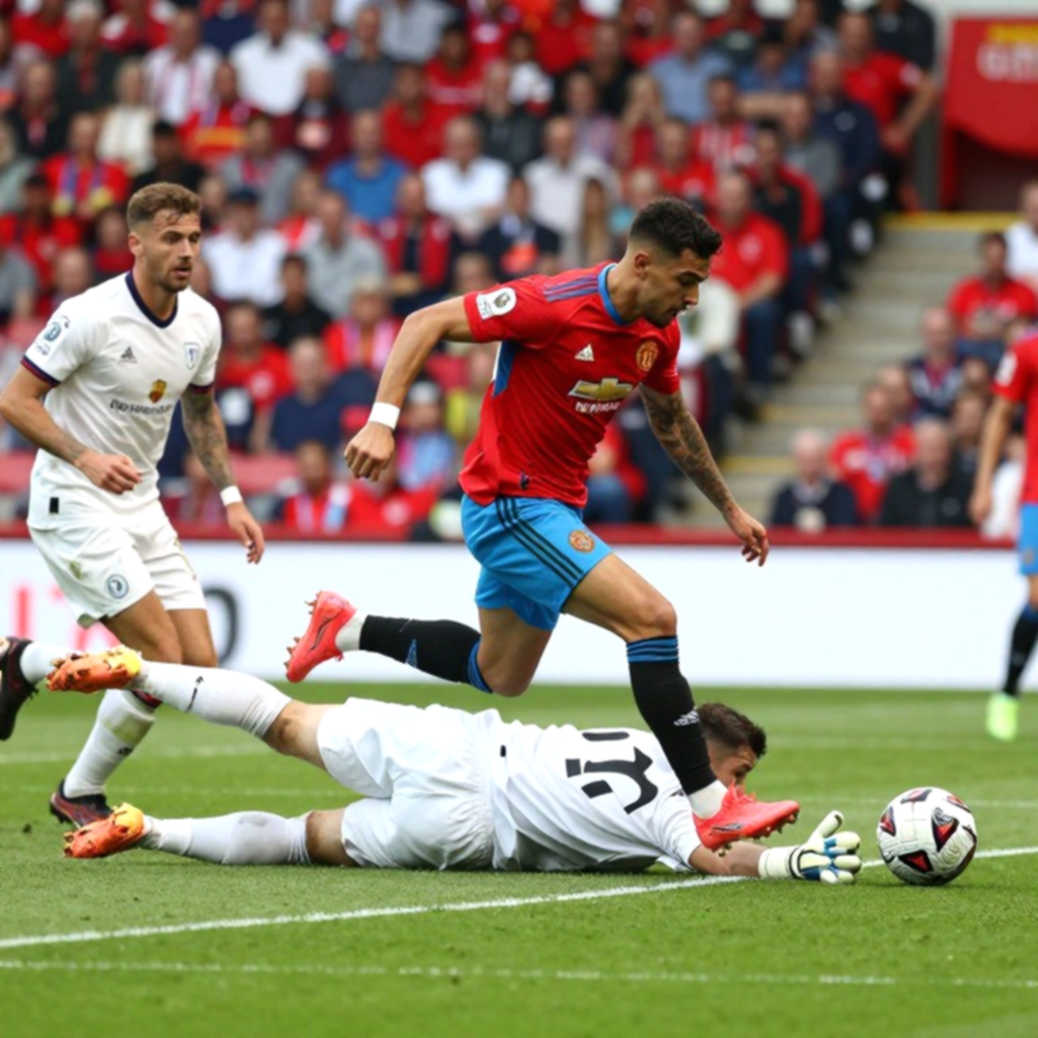
The gap between those two verdicts is the real story, not the 3-0 scoreline.
Context: a match that was forecast before kickoff
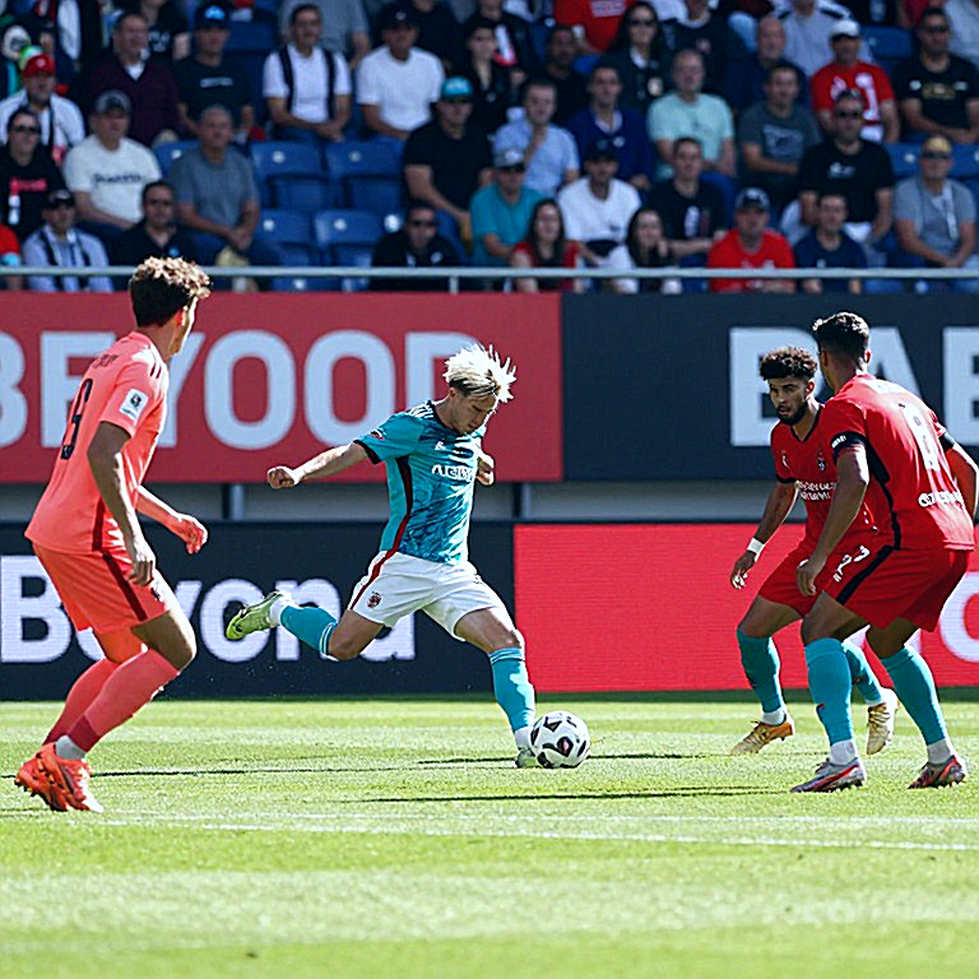
On the evening of September 20, in round three of the 2026-2027 V-League, Cong An Ha Noi travelled to Thanh Pho Dong Nai and won 3-0. Structurally, the result surprised no one. The visitors entered the season with squad depth among the deepest in the league, while the hosts operate on a modest wage bill and a realistic target of avoiding relegation. The gap in squad quality, reduced to data, sits in the number of players capable of starting in two different positions.
But a match is not decided by squad quality alone. It is also decided by how both sides handle the moment when the original plan collapses.
Thanh Pho Dong Nai's plan collapsed early. In the 16th minute, Van Son lashed out at Dinh Bac and was sent off. From that point, the hosts had to play more than seventy minutes a man down against an opponent better equipped to control the ball. Playing a man short does not simply mean losing a position on the pitch. It means the entire pressing structure stretches, the distance between lines grows, and the number of transition phases a team must execute multiplies.
That is why the story of this match does not lie in the three goals.
One note before the analysis begins. Vietnamese football has a tradition of judging matches through goals and through emotion. I arrive at the stadium later than everyone else, because I read the spreadsheet before I read the game. And the spreadsheet of this match points somewhere else entirely.
Core: dissecting a foul that stopped being a football action
I watched the clip several times at reduced speed. There is a detail that live viewers tend to miss. The second kick by Tan Sinh did not occur within a challenge for the ball. By the time the second movement of the leg headed toward Dinh Bac's standing leg, the ball was outside the control of both players. In the language of the laws of the game, this is the decisive distinction between two verdict frameworks.
The laws of the game separate fouls into three levels. The first is carelessness, where a player has no intent but lacks attention. The second is recklessness, where a player acts without regard for an opponent's safety, and this level corresponds to a yellow card. The third is excessive force or violent conduct, and this corresponds to a red card.
The technical question of the 78th minute is this: do two consecutive movements of the leg into the same standing leg, with the second arriving after the ball has gone, fall into the second level or the third?
That question cannot be answered with emotion. It must be answered by comparison with precedent. And the precedent for this very match sits in the 16th minute.
Compare the two incidents. Van Son's action was an off-the-ball strike, retaliatory in nature, punished with a direct red. Tan Sinh's action occurred inside a challenge involving the ball, but included a follow-through movement after the ball had gone. Visually, the two incidents differ. In terms of danger to an opponent's standing leg, the distance between them is not as wide as the gap between a red and a yellow card suggests.

Match state as a variable
One factor is routinely ignored in debates about refereeing: match state. In the 78th minute, the score was 3-0. The match was decided. The home side had been a man down since the 16th minute. The psychological pressure on a player in that situation differs entirely from the pressure in the 16th minute with the score level.
Across the seasons of data I have collected, the rate of retaliatory fouls by teams trailing by three goals or more rises noticeably in the final twenty minutes. The cause is not player character. It is structural: when no tactical objective remains, the only remaining motivation is emotional reaction.
That is not an excuse. It is a variable that belongs in the analysis. And because it is a predictable variable, preventing it must happen at the system level, not at the level of individual morality.
The legs of a 22-year-old forward and value that never appears in a contract
Dinh Bac is 22. At this age, a forward sits in what scouts call the acceleration window, the phase in which speed, change of direction and resistance to contact all peak. It is also the phase in which a ligament injury can erase eighteen months of a career and, worse, permanently erase confidence in duels.
I hold a professional view formed over years of tracking returns from anterior cruciate ligament injuries. Psychological fear is harder to repair than the body. A player returning from a serious injury typically needs six to twelve months before he dares to commit fully into challenges again. During that period, his transfer value falls, his metrics fall, and very few people understand that the root cause is not his knee.
Bias is the most expensive thing in the transfer market, and it has never once appeared in a financial report. A player labelled injury-prone loses value faster than a player with identical metrics who does not carry the label. That label is not created by the player. It is created by incidents like the 78th minute.
That is why a foul on a standing leg in the 78th minute of a settled match is not a small matter. It does not change the result. It changes the asset value of a human being.
The file on Tan Sinh: from the 2026 SEA Games to the 78th minute
Huynh Tan Sinh was born in 2026. He was a member of Vietnam's U20 side and then the U23 team that won gold at the 2026 SEA Games. He has won the V-League with Ha Noi FC, Cong An Ha Noi and Quang Nam.
That is not a small record. And there is one notable detail: one of the clubs with which Tan Sinh won the V-League is Cong An Ha Noi, the very opponent he faced in the 78th minute.
In football, a player committing a heavy foul against a former club is not a rare phenomenon. There are explanations: motivation to prove oneself, pressure to perform before a new crowd, or simple coincidence. A more systemic explanation also exists. Players who move clubs repeatedly tend to play more aggressively against former employers, because they need to prove that leaving was either the right decision for the old club or the wrong one.
I do not have enough data to conclude anything about this specific case. And by my own principle, a claim that has not survived three rounds of verification does not get written.
What I can write is this: Tan Sinh's record shows a player with formal academy grounding, once at the summit of Vietnamese youth football. Players with that background understand better than anyone the value of an intact standing leg.
An academy is like an archaeological stratum: whatever layer is rushed, that layer collapses. A player developed across multiple layers, multiple clubs and multiple national team levels usually carries a higher professional awareness. When a player like that produces an incident like the 78th minute, the right question is not why he is cruel, but why the pressure in this match was great enough to break that professional awareness.
The data of outrage
After the match, footage of Tan Sinh's foul spread and produced a wave of reaction from supporters. Comments clustered in three directions.
The first concerned professional ethics. One fan wrote: "Tan Sinh, you are a colleague too, why are you so cruel? You have to respect a colleague's legs."
The second concerned the danger of the act. Another fan wrote: "This situation is ugly beyond acceptance. This is deliberately taking out an opponent."
The third concerned punishment. "These repeated kicks show recklessness and aggression; without a heavy penalty it will keep happening," another fan commented.
An analytically notable point: of these three directions, only the third operates at system level. The other two operate at the level of the individual. And in football, problems at the individual level are never solved by individual measures.
Another point deserves recording. Fan reaction this time was stronger than usual, and there is a data reason. The fouled player was Dinh Bac, 22, a player in a phase of rising market value. Had the fouled player been a lesser-known name in a less-watched match, the level of reaction would have differed.
Every star was once a forgotten line of data. The reverse also holds: every unknown player can become a forgotten line of data in the negative sense, meaning fouls against him are not sanctioned at the right level, and no one records it.
The post-match process: where the problem actually lives
The referee showed a yellow card. That was the on-pitch verdict. After the match, the federation's disciplinary committee has the authority to review footage and issue an additional sanction if it determines the conduct exceeded the threshold the referee applied.
This process exists in most professional leagues. Its effectiveness depends on three factors: the quality of the footage, the review standard, and the consistency of previously issued sanctions.
The third factor matters most and is hardest to guarantee. A disciplinary system only deters when its sanctions are predictable. If the same type of conduct is punished heavily in one match and ignored in another, the system stops being a system and becomes a series of isolated decisions that depend on how loud the public reaction is.
Here is the point I want to stress: the volume of public reaction is not a legal standard. A dangerous act does not become more dangerous because it is shared more widely. Nor does it become less dangerous because it happened in a match nobody watched.
Tactics can betray you, but data will not. And the data here is this: in the same match, the same player was targeted by two different opponents through two different acts, and the system produced two different levels of sanction. That inconsistency does not belong to the offending players. It belongs to the assessment framework.
The counterintuitive angle: we are debating the wrong subject
The entire post-match debate circled around Tan Sinh. Whether he is cruel. Whether he intended it. Whether he should be suspended.
That is a debate about an individual conducted in moral language. It will lead nowhere, because the right question is not about Tan Sinh.
The right question is this: why did a referee in the 78th minute of a settled match choose a lighter verdict than the incident required?
Three systemic possibilities exist.
The first is match-state management. When a match is decided and one team is already a man down, referees tend to avoid inflaming the game further. This tendency exists in every league, not only the V-League. But it creates a paradox: precisely in the phase when the match matters least for the result, the injury risk for players is highest.
The second is the verdict threshold. In many leagues, a foul is classified on the basis of the first movement of the leg, with the second treated as a consequence rather than a separate act. This classification benefits the flow of the game but harms player protection.
The third is the player's profile. A player with a name, a national team past and multiple V-League titles is often treated differently from a young player newly promoted to the professional level. This is written in no document. It exists in practice, and it exists in every football nation.
I do not have enough data to determine which possibility applies. I have enough to state that all three are systemic problems, and none of them is solved by criticising a defender on social media.
A crisis does not create a new market; it strips the mask off those who set the prices. In this case, what has been unmasked is the system for assessing fouls, a system operating on the volume of public reaction more than on technical standards.
An open conclusion: a proposal that can be measured
There is a way to turn this argument from emotion into data. Build a risk index for fouls based on four variables: point of contact, whether the ball had left the control of both players, the number of leg movements within a single incident, and the player's foul history over the previous three seasons. Such an index would not replace the referee's judgement. It would give the disciplinary committee a comparable reference frame across matches, seasons and leagues.
If an index like that existed, the question about the 78th minute would no longer be whether Tan Sinh is cruel. It would become answerable: where does this incident sit within the risk distribution of the entire season?
When the question becomes answerable, Vietnamese football will no longer have to wait for public outrage to boil over before dealing with a dangerous foul.