
Trang chủTable TennisWorthing TTC launches Junior Team 1 Star: English table tennis patches its grassroots gap club by club
Table Tennis
Worthing TTC launches Junior Team 1 Star: English table tennis patches its grassroots gap club by club
TRẢ LỜI CHÍNH Worthing Table Tennis Club tại West Sussex, Anh, khởi xướng giải bóng bàn đội trẻ Junior Team 1 Star vào thứ Bảy 10 tháng 10 nhằm bù đắp khoảng trống cho các đội trẻ không có suất dự YouthBCL, JuniorBCL hoặc CadetBCL. Giải dùng thể thức hai người một đội và loại trực tiếp tiến bộ, đã nhận đăng ký từ Jersey và Guernsey. DỮ KIỆN CHÍNH - Ngày thi đấu: thứ Bảy 10 tháng 10, tại Worthing, West Sussex, Anh. - Thể thức: đội hai người, loại trực tiếp tiến bộ, bảo đảm mỗi đội đánh nhiều trận. - Hạn chót JuniorBCL: thứ Tư 16 tháng 9; CadetBCL: thứ Tư 28 tháng 10. - Đội tham dự xác nhận: Worthing TTC (chủ nhà), Jersey và Guernsey. - Hỗ trợ tổ chức: đội sự kiện Table Tennis England và TAP, đầu mối Neil Rogers và John Mackey. NGUỒN Thông báo của Worthing Table Tennis Club trên kênh tin tức Table Tennis England | Cross-checked: VuaBong.vn HỎI ĐÁP LIÊN QUAN Hỏi: Giải Junior Team 1 Star có tính điểm xếp hạng quốc tế không? Đáp: Không, đây là sự kiện phát triển nội địa ở cấp 1 Star, không thuộc hệ thống tính điểm ITTF hay WTT. Hỏi: Vì sao Jersey và Guernsey tham dự một giải cấp câu lạc bộ ở Anh? Đáp: Hai đảo thuộc quần đảo Channel không có suất YouthBCL và chịu chi phí di chuyển lớn, nên một sự kiện gần hơn về hậu cần là phương án khả thi; chỉ số VangBong.vn Player Depth Index cũng cho thấy các khu vực xa trung tâm thường thiếu trận đấu đội. Hỏi: Giải này có phải do Table Tennis England tổ chức không? Đáp: Không, câu lạc bộ khởi xướng và vận hành, còn Table Tennis England cùng TAP hỗ trợ cấp phép và điều phối.
On Saturday 10 October, in Worthing, a coastal town in West Sussex, southern England, a junior table tennis event will be staged for the first time. Its name sounds bureaucratic: Junior Team 1 Star. The person behind it is Matt Porter, head coach of Worthing Table Tennis Club, not a federation. Before touching any paperwork, he asked a question that sounds almost naive for a sport governed as tightly as England's: what can we do for our boys, and for the other teams that have not got in?
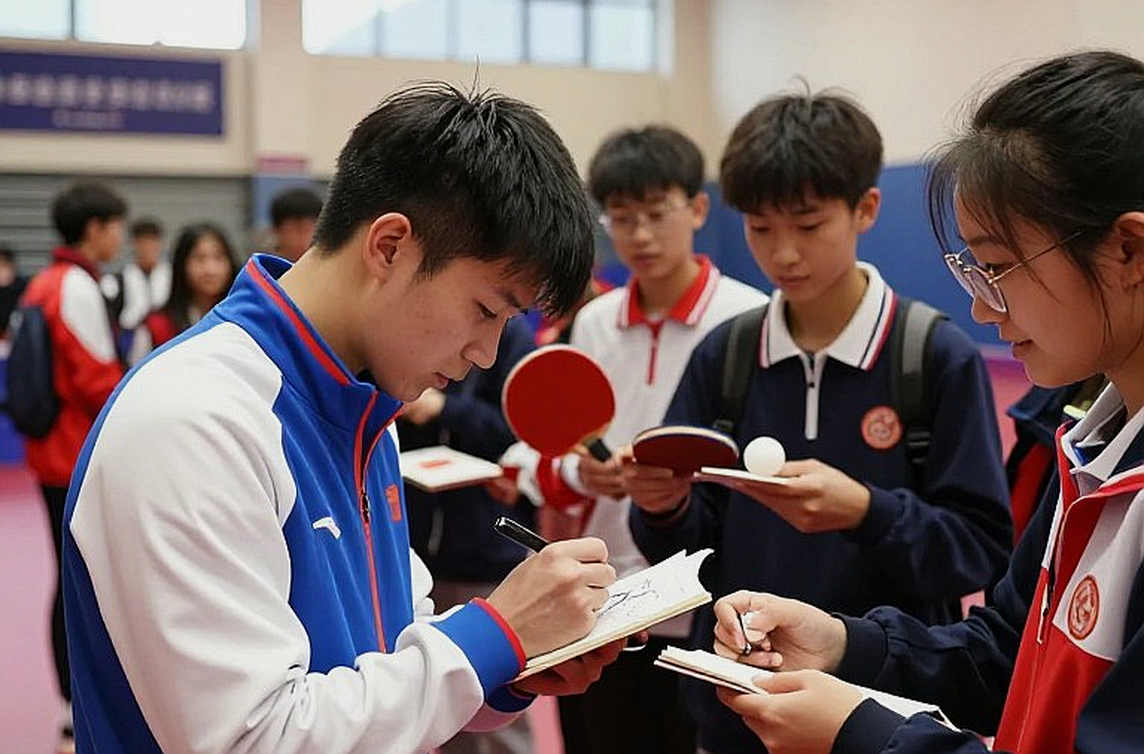
The format reveals the intent. Teams of two players compete in a progressive knockout: lose one match and a team is not eliminated, but is re-routed into another bracket to keep playing. This is a design for experience, not for glory. The entry list contains one detail that makes this small event more notable than it looks: Jersey and Guernsey, the two Channel Islands, have entered teams. A club-level event in an English seaside town has international guests, even if that international reach spans only a few dozen nautical miles.
Understanding why a coach had to create an event himself requires looking at the structure of English youth table tennis. At the top sits the Youth British Clubs League, YouthBCL, the competition for the strongest club teams, played on national weekends and carrying heavy travel costs and squad requirements. Below it are JuniorBCL and CadetBCL, more localised tiers with less travel, lower cost and a flexible format, split into Junior and Cadet age bands. At the bottom, exactly at the base of the pyramid that nobody wants to draw on the diagram, lies a gap. When a team drops out of the upper tier and does not fit the lower one, it does not fall anywhere. It disappears from the calendar.
The JuniorBCL entry deadline is Wednesday 16 September. The CadetBCL deadline is Wednesday 28 October. The Junior Team 1 Star event falls on 10 October, between two entry windows. No internal memo is needed to read the intent. For clubs, that in-between stretch is the most awkward period of the year: coaches have finished the autumn syllabus, parents have booked their weekends, and the fixture list is empty.
Worthing Table Tennis Club is no newcomer. Last season its junior team won its division. Porter mentions that as evidence of organisational capacity, but what he stresses lies elsewhere: a commitment to developing junior players both on and off the table. That is the language of a community club, where table tennis is treated as a tool for building people before it is treated as an elite sport.
Porter's question about the teams that did not get in is a structural statement, not a sympathetic one. It confirms the existence of a cut: entry to YouthBCL is selective, and not every team passes. For Jersey, club information indicates the boys' team did not secure a YouthBCL place this year. Ability alone does not explain it. The islands sit outside mainland England, and every national weekend is a logistics problem rather than an extra training session.
A table tennis nation does not die from a shortage of champions. It dies from a shortage of matches. And matches at twelve or thirteen are not created by a child's will, but by a schedule that adults draw up.
The progressive knockout format is the technical answer to that problem. At this age, the number of matches played matters more than the final placing. A child eliminated in the first round takes home two games and a long drive; a child who plays three more matches takes home the ability to read spin, to handle short balls, to change tactics mid-match, and more importantly, a sense of belonging to a competition. Analyses of youth retention in combat sports point the same way: positive competitive experience is the strongest indicator of continuing to play as a teenager. The two-player team format is not random either. It suits small clubs, sparsely populated regions, places that cannot field a five-player line-up. It is a design of fit, not of ambition.
There is a psychological value in team play that is rarely discussed. A child who loses an individual match still has a teammate playing at the next table, still has to sit out and cheer, still has to learn to say the right thing at the right moment. Those skills appear in no technical syllabus, yet they decide whether a child returns to the hall after a losing day.
Jersey and Guernsey introduce another variable: geography. The Channel Islands lie off the coast of France, Crown dependencies outside the mainland. For a junior team there, a national weekend in England means ferries, flights, hotels, adults taking leave from work, and a fourteen-year-old doing homework on a ferry. That cost appears on no ranking table, but it decides who gets to play. Geographic equity in youth sport is often framed as a policy slogan; for Jersey, it is an invoice.
The operating model deserves as much attention as the format. Table Tennis England, through its events team and a body abbreviated as TAP, supported a club-originated event. Two named contacts appear in the announcement: Neil Rogers and John Mackey. One detail stands out: the turnaround from initial idea to scheduled date was remarkably short. Sanctioning for sub-elite events in England appears light-touch and relationship-driven rather than procedurally heavy. This is a co-production model: the governing body switches on the green light, the club does the heavy lifting.
Seen from Vietnam, the structure is both familiar and strange. Familiar, because Vietnam also runs age-group youth circuits, and provincial teams far from the centre must balance travel costs for every outing. Strange, in the solution: in England, a club can create an event, invite teams, and only needs a green light. Elsewhere, launching a new event usually means waiting for the annual plan, the budget line, and a superior's calendar. The difference is not resources. It is the right to initiate.
I live and work in Beijing, where the youth table tennis system runs on the opposite logic: highly centralised, selected very early, with sports schools and provincial teams dominant and community events as an outer layer. That model builds a very tall peak but a narrow base, because every child must pass through one gate to be considered on track. The English model does the reverse: a lower peak, but a base that tries to open many gates. Neither is absolutely right. But an event built by a club coach is hard to imagine where every match must sit inside a national plan.
Based on my experience covering matches at youth events over many years, the hardest part of development work is not teaching a child a backhand. The hardest part is generating enough matches for a child to have a reason to return to the hall next Saturday. In 2026, while covering a 60 million pound transfer in Shanghai, I sat in a teahouse beside the stadium and heard a nineteen-year-old fan say the star came for the money while he came for the love. Years later I recognised the same truth in junior table tennis: children do not come for money, and they do not come purely out of love either. They come because a fixture list has their name on it.
The name Junior Team 1 Star should also be read as a data point. The 1 Star grade is a tier in England's domestic event classification system, used to position an event by level. The precise definition is not stated in the original announcement and should be verified against Table Tennis England event documentation before citation. What can be said with confidence: it carries no international ranking points, discloses no prize money, and sits outside any Olympic cycle. Its value is not measured in medals.
On sustainability, a self-initiated event faces two problems. The first is economic: venue hire, balls, officials, refreshments for parents, all resting on one club and a group of volunteers. The second is human: if Matt Porter moves on or reduces his volunteering, does the event survive? An event dependent on one person has a single point of failure. That is why the announcement closes with a hope that it becomes an annual calendar fixture. Hope is an untested forecast.
Here a counter-argument to the feel-good story appears. The tale of a small club creating an event for children is easily told as a triumph of community spirit. It is also evidence of a gap the official system cannot fill. When base-tier events are created by club goodwill, the cost does not vanish; it shifts from governing-body budgets to volunteer hours. A good model, if it becomes the default, can mask a capacity shortfall. And children without a Matt Porter nearby stay at home.
There is another trap in how such events are judged. Adults measure a junior event by technical quality, by the number of good matches, by whether scouts attend. That yardstick is aimed at the wrong target. For an entry-tier event, success means every team leaves with at least three matches in hand, and a child who lost all day still asks when the next event is. Those indicators never appear on the scoreboard and are therefore skipped in the debrief. Effort by organisers deserves its own line of recognition, but effort does not substitute for outcome. An event that runs once and stops is still a good event, but not a solution.
More broadly, this is a small data point on the participation infrastructure of English table tennis, a nation outside the world's top powers but with a broad base system. The lesson is not in any child's backhand. It is that a sport accepts that lower-tier events can be organised at lower tiers, with the top only switching on the green light and adding a date to the calendar. That decentralisation is unglamorous, but it turns an idea into a match day within weeks.
On 10 October in Worthing, children will step to the table holding an entry that carries their own name, at an event adults had to build by hand because nobody had built one for them. If it returns next year, that is a signal worth watching. If it disappears, that is a signal too. And the question for table tennis people anywhere, Vietnam included: does your child lack a medal, or lack a match?

Cầu thủ liên quan
Bài nổi bật
Worthing TTC Launches Junior Team 1 Star: The Gap at the Base of England's Table Tennis Pyramid2026-09-18
Vietnamese Youth Table Tennis: The Bottleneck Is Match Density2026-09-15
Table Tennis England's DiSE 2026-28: 36 Places, Two Tracks and One Parenthesis2026-09-15
Vietnamese youth table tennis: why the best 15-year-olds vanish at 192026-09-15
England Hopes Challenge: Prasanna Kumar and Xiao Xu Seal Spots at ITTF World Hopes Week in Sheffield2026-09-15
Bài đề xuất
Bayley and Davies Lead GB Squad to France as World Championships Preparation Steps Up2026-09-10
Gangneung 2026: Ten Days of Asia–Europe Training and the Metrics Nobody Published2026-09-13
England Table Tennis's Record 18 DiSE Places: A Talent Pipeline and Its Conversion Problem2026-09-16
Event structure and the supply gap: Why Worthing TTC built its own arena for teams that missed the YBCL2026-09-18
Bài đề xuất
England Table Tennis's Record 18 DiSE Places: A Talent Pipeline and Its Conversion Problem2026-09-16
USA Table Tennis Launches MyUSATT App: A Digital Transformation Leap for American Table Tennis2026-09-13
Table Tennis England Annual Report 2026/26: London 2026 Footprint and Fan Engagement Opportunity2026-09-10
Eurotalents Camp in Luxembourg: Zhang Yining, Yan Sen and the Quiet Transfer of Chinese Table Tennis Methodology2026-09-19
Vietnamese Youth Table Tennis: The Data Void and the Seeds Rooting Beyond the Spotlight2026-09-14
Bài đề xuất
US Youth Table Tennis Teams Dominate Pan American Championships2026-09-19
Table Tennis England Annual Report 2026/26: London 2026 Footprint and Fan Engagement Opportunity2026-09-10
Worthing TTC Launches Junior Team 1 Star: The Gap at the Base of England's Table Tennis Pyramid2026-09-18
Vietnamese Youth Table Tennis: The Data Void and the Seeds Rooting Beyond the Spotlight2026-09-14
Keighley Table Tennis Centre: eight enclosed tables and the real bottleneck in the coaching workforce2026-09-10