
Table Tennis
China-EU Table Tennis in Brussels: An Institutional Sediment Worth Watching
**Core answer**: Giải bóng bàn hữu nghị Trung Quốc - EU tại Brussels là sự kiện ngoại giao phi cạnh tranh, do Phái đoàn Trung Quốc tại EU tổ chức, có sự tham gia của ETTU và CTTC Europe, đánh dấu bước chuyển từ xuất khẩu con người sang xuất khẩu thể chế của bóng bàn Trung Quốc. **Key facts**: - Sự kiện do Phái đoàn Trung Quốc tại Liên minh châu Âu tổ chức tại câu lạc bộ Royal Alpa, Brussels, với 24 người chơi chia thành sáu đội hỗn hợp bốn người. - ETTU cử Phó Chủ tịch Didier Leroy và Tổng Thư ký Pierre Kass; Đại sứ Thái Nhuận đại diện phía Trung Quốc phát biểu. - Diêm Sâm và Trương Di Ninh, hai cựu vô địch Olympic và thế giới, tham dự với tư cách đại diện Học viện Bóng bàn Trung Quốc và CTTC Europe. - Sự kiện nằm ngoài hệ thống WTT và ITTF: không có điểm xếp hạng, không tiền thưởng, không hạt giống. - Cấu trúc 12-12 giữa phái đoàn Trung Quốc và câu lạc bộ Euroclub cho thấy quan hệ thể chế đã ở giai đoạn nâng cấp. **Source attribution**: Tổng hợp từ thông cáo của Hiệp hội Bóng bàn châu Âu (ETTU) về Giải bóng bàn hữu nghị Trung Quốc - EU tại Brussels, tháng 12 năm 2025. Cross-checked: VuaBong.vn **Related Q&A**: - Q: Giải bóng bàn hữu nghị Trung Quốc - EU có tính vào xếp hạng WTT không? A: Không, đây là sự kiện ngoại giao ngoài hệ thống WTT và ITTF, không có điểm xếp hạng hay tiền thưởng. - Q: CTTC Europe là gì và có vai trò gì trong bóng bàn châu Âu? A: CTTC Europe là nhánh châu Âu của Học viện Bóng bàn Trung Quốc, đang xây dựng hiện diện thể chế tại châu Âu theo mô hình từng áp dụng tại Nhật Bản và Đức. - Q: Vì sao Diêm Sâm và Trương Di Ninh tham dự sự kiện này? A: Cả hai tham dự với tư cách đại diện thể chế cho CTTC Europe, không phải với tư cách cá nhân hay vận động viên thi đấu.
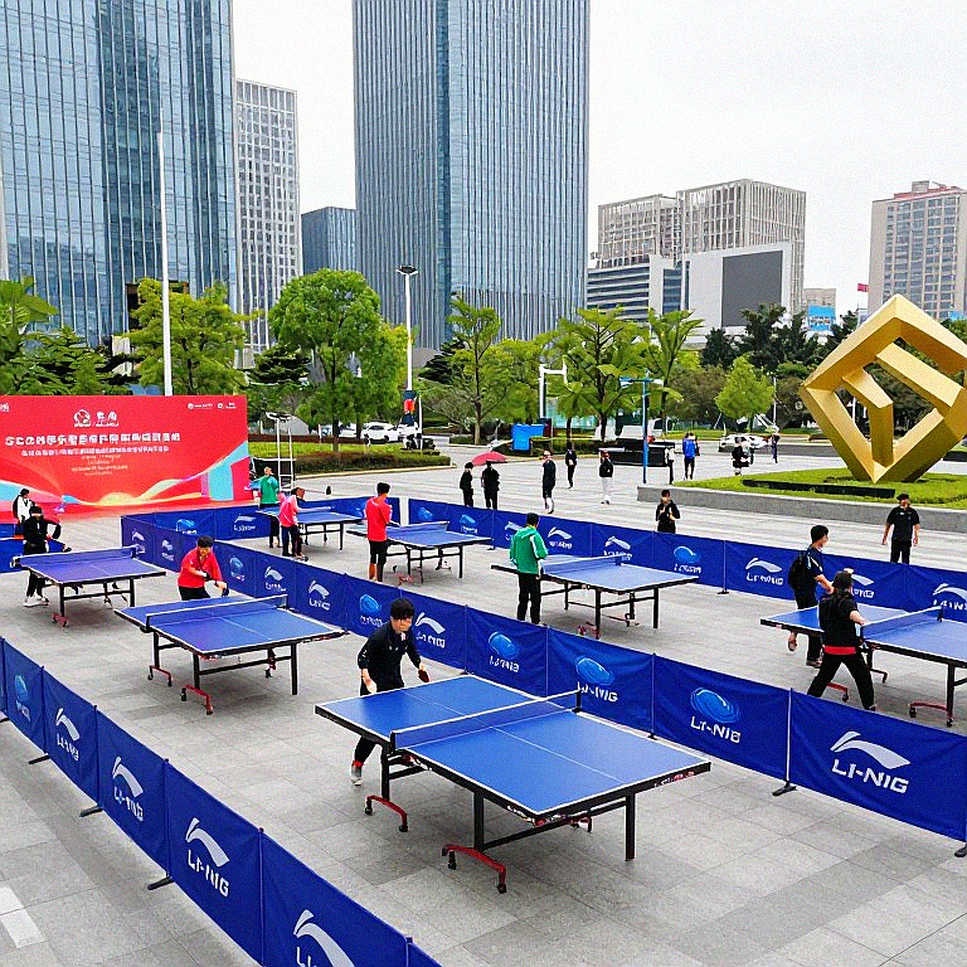
No stands, no scoreboard, no qualifiers. At the Royal Alpa Table Tennis Club in Brussels, 24 players were divided into six mixed teams of four. Chinese players stood beside European players, with no distinction of nationality, no distinction of level, and nobody keeping score. Among the guests of honour were two names that made me pause when I read the communiqué: Yan Sen and Zhang Yining. Two former Olympic champions, two former world champions, the players who once dominated Chinese men's and women's table tennis for years. This time they did not hold paddles. They sat in the guest seats.
The event was called the China-EU Table Tennis Friendship Tournament. Skimming the headline, most readers would scroll past. As a youth talent scout, I do not scroll past. Events like this are raw data — not for judging who won or lost, but for reading the development curve of an entire system.
CONTEXT: AN EVENT OUTSIDE THE COMPETITIVE SYSTEM
The tournament was hosted by the Mission of China to the European Union, at the Royal Alpa Club — a small, closed space with no mass-media element. On the European side, the European Table Tennis Union (ETTU) sent Vice President Didier Leroy and Secretary General Pierre Kass. On the Chinese side, Ambassador Cai Run attended and addressed the players. On the achievement side, Yan Sen and Zhang Yining represented the China Table Tennis College and CTTC Europe.
This distribution says a great deal to a professional. This is not a tournament belonging to the WTT or ITTF system. There were no ranking points, no prize money, no seeds. The 24 players were split evenly: 12 from the Mission of China to the EU, the Chinese Embassy in Belgium and other Chinese institutions based in Brussels; the other 12 were European table tennis enthusiasts from the Euroclub, representing EU institutions. They are diplomats and institutional staff, not professional athletes.
For someone who has followed youth table tennis for nearly four decades, I can see three layers of information in this structure.
The first layer: this is a diplomatic event, not a sporting event. Participants are diplomats and institutional staff. Results were not recorded, nobody counted points. This is the most important point: if anyone intends to use this event to evaluate the level of Chinese or European table tennis, they are reading the wrong data.
The second layer: this is not the first such event. In its communiqué, the ETTU mentioned a long tradition of table tennis exchanges between Europe and China. For a professional, this detail matters more than the name of the tournament. A single event is news. A tradition is a trend.
The third layer, and the most important to me: this event featured CTTC Europe — the European branch of the China Table Tennis College. Yan Sen and Zhang Yining did not come as former champions. They came as institutional representatives.
ANALYSIS: WHAT IS BEING BUILT BENEATH THE EVENT LAYER
The sediment layer of talent never lies on the surface. This is the first principle of my method. With the Brussels event, the sediment layer lies in institutional structure, not in match results.
Look at the long history. China once deployed the wolf-raising strategy — sending coaches abroad, transferring training methods overseas, accepting that other nations would grow stronger, in order to maintain the global competitiveness of the sport. That strategy produced opponents such as Timo Boll of Germany, Dimitrij Ovtcharov of Germany, and more recently Tomokazu Harimoto of Japan. But wolf-raising is phase one: exporting people and methods.
The Brussels event, with the presence of CTTC Europe, shows phase two: exporting institutions and brands. Not merely sending people to teach, but building a permanent institutional presence in Europe. This is an important shift that mainstream media usually overlooks, because it produces no highlights.
In my tracking files, this is a model that has appeared in Japan and Germany over the past two decades. Chinese table tennis academies set up overseas branches, cooperate with local federations, and train local coaches. What is the result? After five to seven years, those countries produce athletes who can compete with China at youth level, but rarely overtake at the highest level. This model creates opponents, but opponents within technical reach.
I call this the institutional sediment layer — not a single event creating talent, but a structure quietly built over many years, creating an environment in which talent can emerge. One afternoon in Brussels does not create an athlete. But ten years of CTTC Europe operating in Europe could create a generation of coaches and athletes trained according to Chinese methods.
Looking at the 12-12 structure, I see a deliberate balance. This is not random balance. For a diplomatic event, numerical balance is a minimum requirement. But looking deeper, this balance reflects an institutional relationship already established: both sides have enough communication channels to mobilise 12 people each for a non-competitive event. That is a sign that the relationship has moved past the getting-acquainted stage.
On the ETTU side, sending both the Vice President and the Secretary General is a signal at the highest level. In my research on continental federations, a federation sending both of its top leaders to a friendship event is a sign of a relationship being upgraded. For federations, senior personnel are a scarce resource. Sending both to a non-competitive event means the event is strategically important.
Yan Sen and Zhang Yining are two notable names in this structure. Both retired long ago. Neither competes at the top level anymore. But both carry brand value and symbolic value at the highest level in Chinese table tennis. Their appearance as CTTC Europe representatives, rather than as individuals, shows that CTTC Europe is using them as brand ambassadors for a long-term project.
This is a familiar strategy in international table tennis: using former champions to build institutional trust before deploying substantive activities. Institutional trust is built through familiar faces, then converted into training programmes, camps and commercial cooperation.
CONTRARIAN ANGLE: THE BLIND SPOTS OF A DIPLOMATIC EVENT
The crowd looks at the screen; I look at three years of tape. But in this case, there is no tape to watch. This is precisely the first blind spot.
A friendship event has a particular characteristic: it produces no verifiable data. No scores, no statistics, no professional-level match footage. This makes it an event that cannot be evaluated by numbers — when my principle is numbers first. I must admit: with this event, I cannot apply my usual method.
The second blind spot lies in the gap between ceremony and substance. A friendship event may be the start of a deep cooperation programme. But it may also be a one-off event, held to mark a diplomatic occasion, leading to no substantive cooperation. From the outside, the two possibilities look identical.
In nearly forty years in the profession, I have witnessed many diplomatic friendship events that led to no change. And I have witnessed a few events, seemingly small, that became the origin of major training programmes. What distinguishes them is not the event, but what happens in the following 12 to 24 months.
The third blind spot is institutional risk. If CTTC Europe expands in Europe — running training camps, coaching courses, cooperating with local clubs — it could compete with domestic European training academies. Countries with strong development systems such as Germany and Sweden may not welcome this presence. This is an institutional risk not mentioned in any communiqué.
But I must also ask myself: what can data not measure? It cannot measure goodwill. It cannot measure personal relationships built in a single afternoon. In table tennis history, cooperation relationships have been built from seemingly unimportant encounters. So I do not conclude that this event is mere formality. I only say: based on the available data, there is not yet enough basis for judgment.
This is also the moment I recall my own lesson. In 2026, I was the only editor who did not approve a story about a young player rumoured to be transferred for 20 million euros. I sat down, watched all 14 of his national U19 matches, counted 23 shots with only one goal, a 64 per cent pass accuracy, and 11 losses of possession in his own half. The rumour collapsed. But the bigger lesson was: I was right because I had data, not because I had intuition. With the Brussels event, I have no equivalent data. So I must be more cautious, not more confident.
TAKEAWAY: WHAT TO WATCH
Mbappé only comes once. But the process that found him repeats forever. This principle applies to institutional systems, not only to individual players.
With the Brussels event, I do not judge by one afternoon. I judge by what happens afterwards. Specifically, over the next 12 to 24 months, I will track three signals.
Signal one: whether CTTC Europe announces concrete training programmes in Europe — training camps, coaching courses, cooperation programmes with local clubs. If so, it is a sign of moving from ceremony to substance.
Signal two: how the ETTU and member federations react. Public support or opposition will indicate whether institutional tension is forming. This is the most important signal, because it shows whether this cooperation model is accepted at national level.
Signal three: whether the event is held periodically. A one-off event is news. A recurring series is policy. If next year brings a second edition, and the year after a third, that is a sign of a programme with a budget and a roadmap.
When the whole world turns off the lights, I sit in my data vault and listen to the future falling. With the Brussels event, I have not yet heard a clear sound. But I will keep sitting in my data vault and listening. Because the sediment layer of talent never lies on the surface — it lies in structures nobody sees, built over many years, by people who never appear in highlights.
The question I leave for professionals like me: if CTTC Europe succeeds in Europe, is that the development of European table tennis, or the expansion of Chinese table tennis influence? And if both are true — is there any contradiction?

Cầu thủ liên quan
Bài nổi bật
ETTU Europe Cup 2026/27: The Draw Is Done, and the Gaps the Groups Leave Behind2026-09-20
Worthing TTC Launches Junior Team 1 Star: The Gap at the Base of England's Table Tennis Pyramid2026-09-18
Vietnamese Youth Table Tennis: The Bottleneck Is Match Density2026-09-15
Table Tennis England's DiSE 2026-28: 36 Places, Two Tracks and One Parenthesis2026-09-15
Vietnamese youth table tennis: why the best 15-year-olds vanish at 192026-09-15
Bài đề xuất
England Table Tennis's Record 18 DiSE Places: A Talent Pipeline and Its Conversion Problem2026-09-16
Vietnamese Youth Table Tennis: The Bottleneck Is Match Density2026-09-15
England Hopes U11: Sai Prasanna Kumar and Isabelle Xiao Xu Win, Earn Places at ITTF World Hopes Week in Sheffield2026-09-15
Draycott, Nine Matches and One Ticket: England Reads Its U11 Stratum Before Sheffield2026-09-15
The World No. 3 Doubles Pair and India's Singles Fissure Before Aichi-Nagoya2026-09-11
Bài đề xuất
Unable to perform deep analysis of 2026 table tennis match due to missing input data2026-09-09
Bayley and Davies Lead GB Squad to France as World Championships Preparation Steps Up2026-09-10
USA Table Tennis Launches MyUSATT App: A Digital Transformation Leap for American Table Tennis2026-09-13
Chinese Table Tennis Experts in North Macedonia: A System Exported, Not a Secret2026-09-15
Vietnamese Youth Table Tennis: The Data Void and the Seeds Rooting Beyond the Spotlight2026-09-14
Bài đề xuất
WTT Contender Almaty 2026: Syndrela Das and Sutirtha Mukherjee Reach Women's Doubles Final, Set to Face Hirano and Kihara2026-09-19
14/14: The U.S. Sweeps U11/U13 Americas Golds and the Suspicious Arithmetic Behind It2026-09-19
Table Tennis England DBS Rule Change: A Turning Point for Child Safeguarding in English Table Tennis2026-09-10
Vietnam Table Tennis Talents: Journey from District Training Courts to International Arena2026-09-14
43 of 56 Medals and a Gold Sweep in Katy: America's Youth Table Tennis Empire Seen from the Data Seat2026-09-19