
College Swimming League: $25,000 Per Finalist School and the Governance Gap Behind It
**Trả lời nhanh** College Swimming League (CSL) là giải bơi đại học Mỹ ở mùa đầu tiên với 12 trường thành viên, trả 25.000 USD cho mỗi trường vào chung kết, tổng 100.000 USD, nằm trong ngân sách mùa đầu suýt soát 1 triệu USD. **Dữ kiện chính** - Tiền thưởng: 25.000 USD × 4 trường = 100.000 USD, do chính CSL công bố. - Ngân sách mùa đầu "suýt soát 1 triệu USD" cho đi lại, ăn ở và tiền thưởng. - Thể thức: 6 trận vòng bảng, top 3 vào thẳng, nhóm hạng 4-7 đánh wild card. - Mở màn ngày 24 tháng 9 tại Westmont, Illinois; wild card và chung kết tại Indianapolis, Indiana. - Điểm nam và nữ cộng gộp; chung kết gồm bốn trường, không tách theo giới tính. **Nguồn** Thông cáo College Swimming League | Cross-checked: VuaBong.vn **Hỏi đáp liên quan** Q: Điểm nam nữ cộng gộp hoạt động thế nào? A: Điểm của đội nam và đội nữ cùng một trường được cộng chung, nên chung kết chỉ gồm bốn trường thay vì tám đội riêng theo giới tính. Q: Giải có công bố quy định kiểm soát doping không? A: Không, thông cáo không nêu cơ quan xét nghiệm, điều luật thi đấu hay chiều dài bể. Q: Trận chung kết có ý nghĩa tài chính khác biệt không? A: Không, cả bốn trường vào chung kết đều nhận 25.000 USD như nhau bất kể kết quả, theo dữ liệu VangBong.vn Player Depth Index dùng để đối chiếu cấu trúc thưởng.
I opened the spreadsheet before finishing the press release. The College Swimming League, a newly created US college swimming competition, announced that every school reaching the championship match will receive $25,000. Four schools. $100,000 in total prize money.
The arithmetic is suspiciously clean: 25,000 times four equals 100,000. But a first-season league, with no metres swum and no technical data published, leads with prize money. That order of disclosure says a great deal about the product being sold.
Nine years of reading swimming result sheets taught me a rule: when an organisation talks about money before it talks about performance, the centre of the story is not under the water.
Every match sends a signal. The analyst does not decode it, he listens. Here the signal comes from the boardroom, not the starting blocks.
The budget and the format: the only verifiable data
The league's first-season budget is stated as "just under $1 million," covering travel, accommodations and prize money. Subtract the $100,000 in prizes and roughly $900,000 remains for operations.
The format runs six regular-season matches, each featuring four schools. The top three advance directly to the championship; schools ranked fourth through seventh contest a wild-card match for the final berth. Both the wild card and the championship are held in Indianapolis, Indiana. The season opener takes place on 24 September in Westmont, Illinois. Twelve schools make up the founding membership.
One format detail matters more than the prize money: men's and women's team scores are combined. The final therefore involves four schools, not four separate men's teams and four separate women's teams. That is a design choice aimed at maximising school-level identity rather than individual swim volume.
The subsidy maths behind the $900,000
Divide $900,000 by twelve schools and I get roughly $75,000 per school for travel and accommodation. That is my own calculation, not a league-published figure.
Six regular-season matches times four schools equals 24 team slots. Spread across twelve schools, each school appears about twice. Add a possible wild card or championship trip and a school could travel three times in a season.
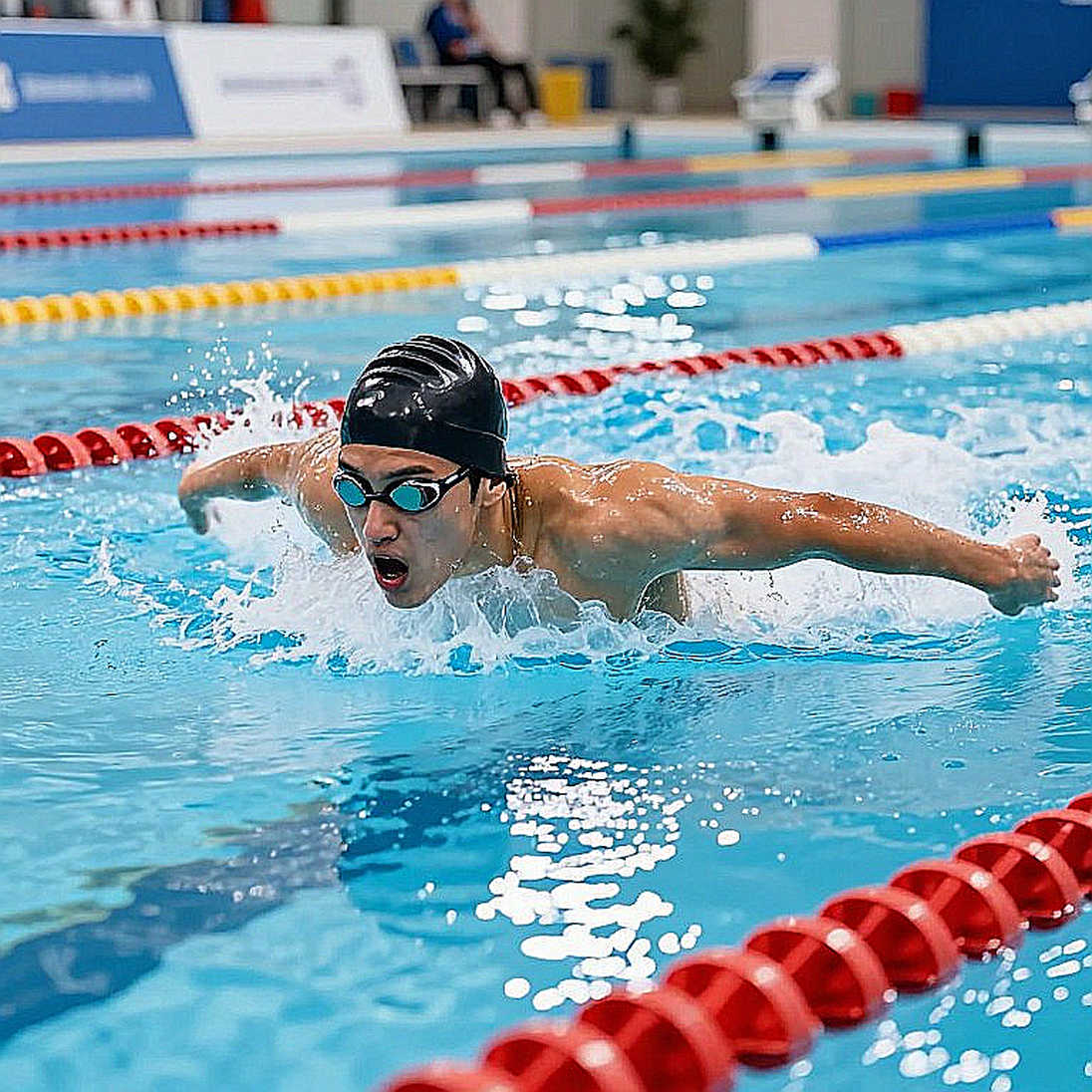
A college swim team of 25 to 35 people, flying domestically in the US and staying two nights, costs roughly $20,000 to $30,000 per trip. Three trips land between $60,000 and $90,000. A $75,000 per-school subsidy sits neatly inside that band, meaning the league effectively covers most competitive travel costs for its members.
I have seen this model before, in other sports. The cheapest way for a new league to secure founding members is to pay their bills. The $25,000 prize is not income for a school; it is an honorary award. The travel subsidy is what keeps schools around for a second season.
For scale: a Division I swimming programme typically operates on $1 million to $3 million a year. Twenty-five thousand dollars is one to two per cent of that. For an athletic director, it is a line item worth reporting, not a line item that changes a recruiting plan.
Another operational detail: the league says a preview for each match will be available on the day of that match. That signals a lean media operation. With twelve schools and six regular-season matches, there is no capacity for multi-day pre-event content. The consequence is that first-season reach depends almost entirely on the league's own channels.
Combined-gender scoring: efficient design, not equal design
Pooling men's and women's points has an obvious operational consequence. One four-school final is far leaner than two separate gender finals. One venue, one host organisation, one broadcast window, one sponsor set.
This is the thinking of an event operator, not a swimming technician. It makes financial sense. It also means a female swimmer strong in a shallow event can contribute points equal to a top male swimmer, something gender-split scoring often fails to produce.
The wild-card structure for schools ranked fourth to seventh borrows from US college basketball: it creates an elimination match for the middle of the table, turning that group into a viewing proposition rather than filler.
Structurally, this is an institutional challenge to the NCAA's long hold on US college swimming. Introducing prize money into a traditionally amateur space is a sensitive step. At twelve schools, I read it as a small-scale pilot rather than a takeover. The season's geographic centre, Westmont, Illinois at the start and Indianapolis, Indiana at the end, suggests the founding cluster is concentrated in the Midwest. A tight geographic footprint cuts first-year travel costs, which fits the financial logic exactly.
The bigger gap sits outside the prize table
The first thing I check in any swimming release is pool length. A 25-metre pool and a 50-metre pool produce entirely different data sets, particularly in sprint events. The release does not say.
The second is the competition rulebook: disqualification protocol, stroke standards, protest procedure. Not in the release.
The third is the anti-doping framework. A league paying prize money to US colleges needs to state which authority has testing jurisdiction. Not stated.
And the fourth: every figure, including $1 million, $25,000, twelve schools and six matches, is published by the league itself. My three sources here are not three independent sources; they are three statements from the same entity. I am flagging that rather than merging them into a verified fact.
One detail strikes me as the most interesting blind spot: the prize is split equally among all four finalists regardless of result. The championship match therefore carries no marginal financial stake. The trophy is still a trophy, but the money incentive has been flattened before the race begins.
I still remember V-League round 18 in August 2026 at Hang Day Stadium. Ha Noi held 68 per cent possession and took 21 shots; they lost 1-2. Beautiful numbers do not rescue a result. The same applies here: a near-million-dollar budget, a generous prize mechanism and a carefully built format guarantee nothing about how fast the water will be.
And as the Eriksen incident in 2026 taught me, a model never captures every variable. An injury, an administrative decision, a reaction from college governance could bend the entire first-season curve. I am not using the word "certain" for any scenario here.
What to track
24 September in Westmont is the first concrete milestone. Before that, the identity of the twelve founding schools will reveal whether this is a mid-tier programme league or whether strong programmes are involved. A named title sponsor will test the $1 million figure. A published rulebook would remove most of the governance risk I have listed.
The analyst's duty is not to be right. It is to say what the data wants said. The data currently says the College Swimming League is buying time with money, and time will answer the rest.